

If you work in a broadcast or media organisation, you already know the pain points of a traditional encoding workflow. An editor finishes a cut in Premiere Pro, exports it, drops it into a watch folder, and waits. Someone else picks it up, checks it landed correctly, renames it to match delivery specs, and manually pushes it into the MAM. Multiply that across dozens of assets a day and you have a workflow held together by folder structures, naming conventions, and a fair amount of hoping nothing breaks.
Mediaflex's integration with Adobe Media Encoder removes that chain entirely.
What the integration actually does
Instead of routing files through folders and polling processes, Mediaflex talks to Adobe Media Encoder directly through its API. Editors trigger an export or publish action from a Mediaflex panel inside Premiere Pro itself, so there's no need to leave the edit suite. From there, the Mediaflex Workflow Orchestrator takes over: submitting the job, monitoring it in real time, and once it's done, registering the finished asset in the MAM with its metadata intact.
The flow looks like this: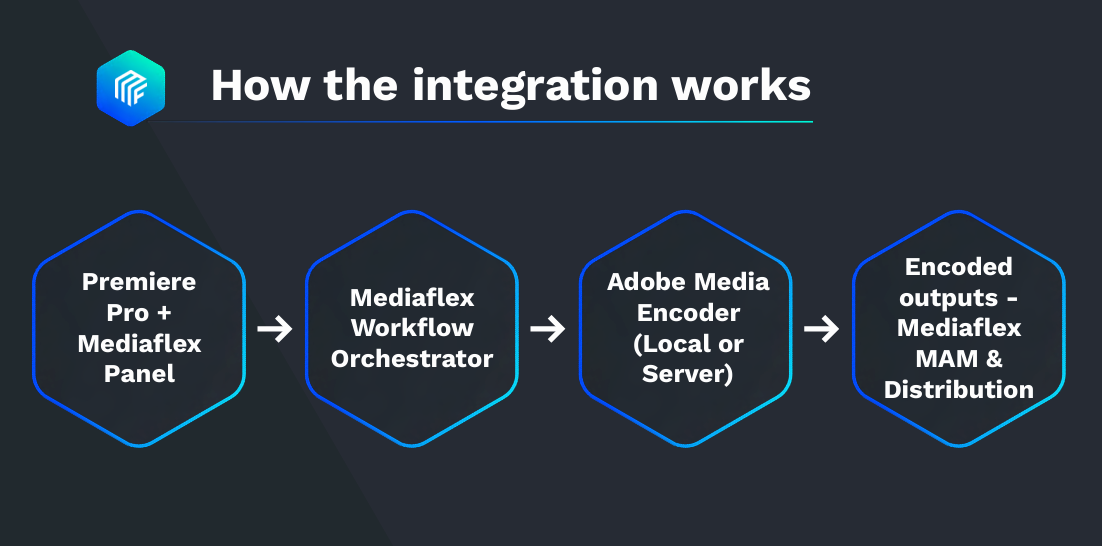
Premiere Pro + Mediaflex Panel → Mediaflex Workflow Orchestrator → Adobe Media Encoder → Encoded outputs in Mediaflex MAM & Distribution
No manual handoffs. No watch folders. No one checking a directory to see if a job finished.
Where this matters day to day
A few use cases show why this isn't just a technical nicety:
Automated proxy generation. Editing copies get created on ingest automatically, so nobody's manually transcoding footage before they can start cutting.
Multi-format delivery in one click. Preset templates generate broadcast, web, and social versions of an asset together, instead of running separate exports for each destination.
Remote and background rendering. Heavy exports get offloaded to local or remote AME servers, so editors aren't stuck waiting on their own machine while a render chews through resources.
Integrated publish to MAM. Once an output is ready, it's ingested automatically with full metadata, ready for distribution, playout, or archive.
Why direct API orchestration beats watch folders
Watch folders have been the default for a long time because they're simple to set up. But simple to set up doesn't mean reliable to run. They offer limited feedback when something goes wrong, they depend on disconnected manual steps, and they don't scale cleanly when you're running jobs across multiple encoders or render servers.
Mediaflex's orchestration layer submits jobs directly through Adobe-supported APIs, captures progress and error events as they happen, and can route work across multiple AME instances. That means fewer naming errors, more consistent outputs, and a system that scales with volume rather than fighting it.
The impact in practical terms
The result is a workflow that's faster to run and easier to trust:
- One single-click action covers export and publish together
- Zero manual file moves or watch folders in the pipeline
- 100% preset-driven, standardised outputs every time
For editorial teams, that means less time managing files and more time editing. For operations, it means centralised visibility into every job, with real-time status and error alerts instead of finding out something failed after the fact.
It's a small shift in where the work happens, from manual steps between systems to a direct connection between them, but it changes how much a team can move through in a day without adding headcount or complexity.
Find our more by downloading the integration brief from the link below.